Introduction
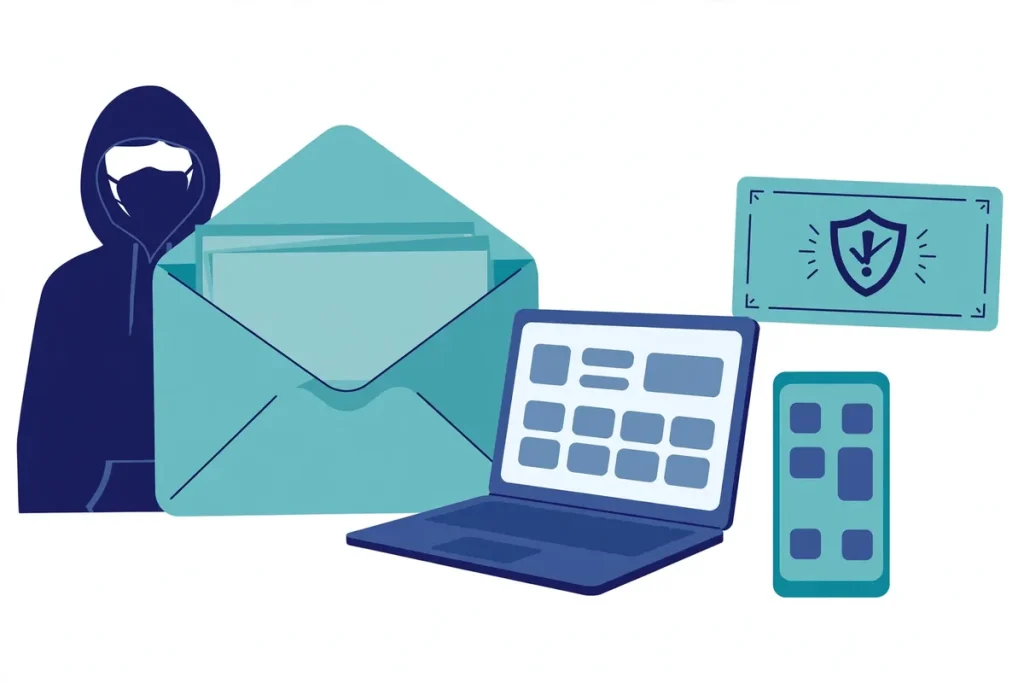
Business email compromise (BEC) is the most expensive email scam in the world — and accounting firms are a prime target. Unlike phishing, which tries to steal a password, BEC tries to trick a person into sending money or data willingly, by impersonating someone they trust.
The FBI reports billions of dollars lost to BEC every year. This guide explains how it works against accounting firms, the five versions you are most likely to see, and the controls that stop it cold.
What is business email compromise?
BEC is a scam where a criminal impersonates a trusted person — your boss, a client, a vendor, a bank — usually by email, and convinces a staff member to transfer money, change bank details, or send sensitive data.
The emails are carefully researched. The criminal may know your firm’s structure, your clients’ names, and your vendor list from your website, LinkedIn, and previous breaches. The message will look normal, use the right names, and arrive at a plausible moment — for example, during payroll week.
The 5 BEC scams that target accounting firms
1. The fake boss (CEO fraud)
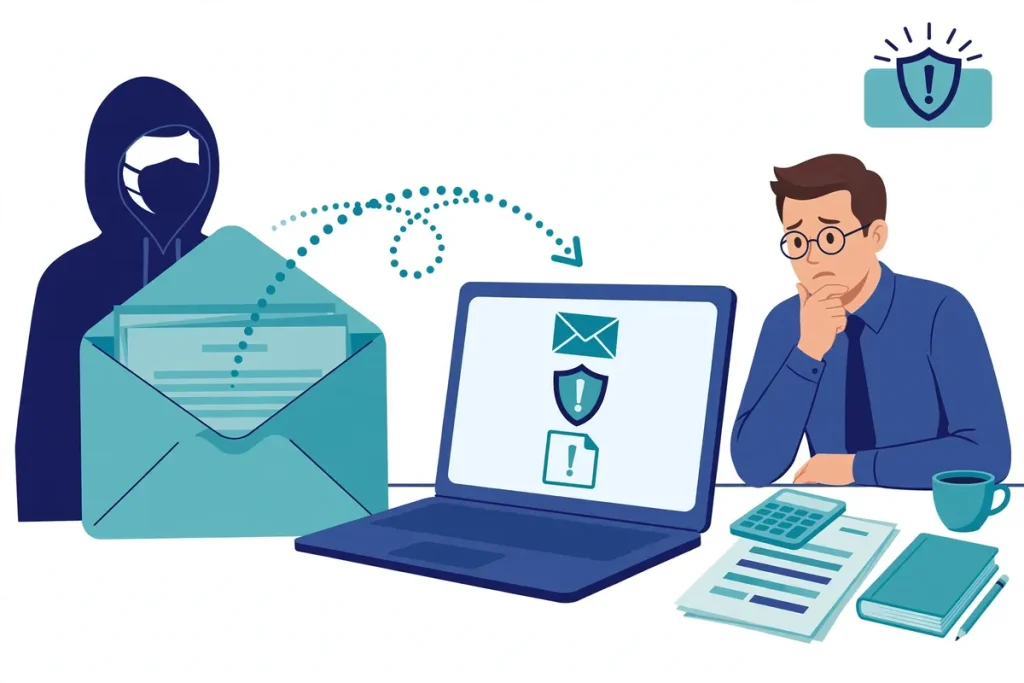
An email that appears to come from the firm owner or a senior partner: “I’m in a meeting — please wire $18,000 to this account urgently, I’ll explain later.” It creates urgency and secrecy, and it targets junior staff who do not want to question the boss.
2. The fake invoice
An email from a “vendor” with an invoice attached and new bank details for payment. The vendor is real; the bank details are the criminal’s. The firm pays a genuine-looking invoice to the wrong account.
3. Payroll diversion
An email that appears to come from a staff member (or a client’s employee) asking to change the bank account for their salary or a refund. The next payroll goes to the criminal.
4. The fake client
A criminal impersonating a client asks the firm to change the bank account for a tax refund or a payment, or to send client documents to a new email address. The firm, trying to be helpful, complies.
5. The hijacked thread
A criminal takes over a real email account — a client’s, a vendor’s, or a colleague’s — and replies inside a genuine email conversation. Because the thread is real, nobody questions the new instructions in it. This is the hardest version to spot.
Why accounting firms are vulnerable
- You move money. Firms handle payments, refunds, and payroll — the exact things BEC targets.
- Your staff are helpful. Accountants are trained to serve clients quickly. Criminals exploit that helpfulness and the pressure of deadlines.
- Your email is public. Firm structure, staff names, and client lists are often visible online, giving criminals everything they need to write a convincing email.
- One person can act alone. In many small firms, one person can approve and send a payment with no second check. That is exactly what BEC needs.
How to spot a BEC email
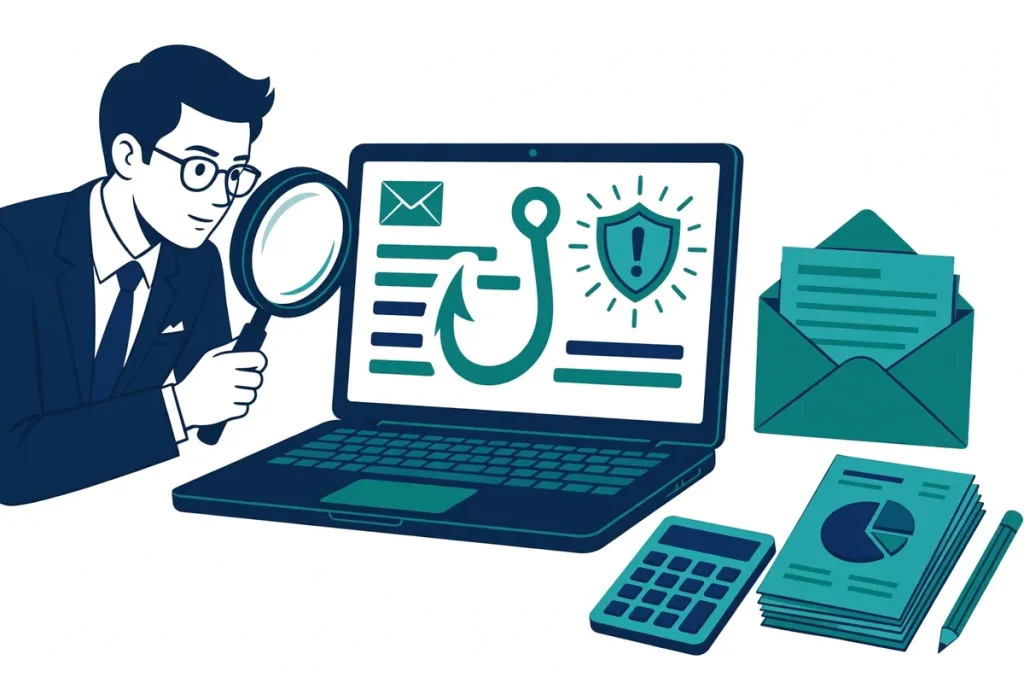
- Urgency and secrecy — “Do this now, don’t tell anyone, I’m in a meeting.” Legitimate urgent requests do not forbid you from verifying them.
- A change of bank details or payment instructions — the single biggest red flag. Any change to where money goes must be verified independently.
- A slightly wrong email address —
partner@yourfinn.cominstead ofpartner@yourfirm.com, or a free email address where a business one is expected. Always check the real address, not the display name. - A request that breaks normal process — a payment outside the usual approval flow, a document sent to a personal email address, a refund to a new account. If it skips the process, stop.
- Tone that is slightly off — the message is plausible but the phrasing, greeting, or signature is not quite how that person writes.
The controls that stop BEC
1. Verify every change of bank details by phone
This one rule stops most BEC. Any new bank account, any change to payment details, any refund to a different account — verify it by calling the person on a number you already have, not the number in the email. No exceptions, even for the boss.
2. Two-person approval for payments
No payment above a set threshold goes out on one person’s authority alone. A second person checks the payee, the amount, and the bank details before it is sent. In a two-person firm, the second check can be a phone call to the client or vendor.
3. SPF, DKIM, and DMARC
These three DNS records stop criminals sending fake emails in your firm’s name, and help you spot emails that fail authentication. Set them up (see our email security guide) and move the DMARC policy to reject.
4. MFA on every mailbox
If a criminal cannot take over a real mailbox, they cannot run a hijacked-thread attack. MFA on email is the single most important technical control against BEC.
5. A clear rule, written down
Put it in your WISP and on the office wall: “No bank details are ever changed on the basis of an email alone. Always verify by phone.” When the rule is written and everyone knows it, no one has to make a judgment call under pressure.
6. Train with real examples
Show the team the five scams above, with examples. Run a short session before tax season and before payroll changes. People who have seen a BEC email are far less likely to fall for one.
What to do if you think you have been tricked
- Contact your bank immediately — a wire transfer can sometimes be recalled if you act within hours. Do not wait until tomorrow.
- Tell your IT support and your security coordinator — check whether an account was compromised, and change passwords from a clean device.
- Tell your insurer — BEC losses may be covered, but policies often have short notification deadlines.
- Report it — to the FBI’s Internet Crime Complaint Center (IC3) and, if client data was involved, follow your incident response plan and the IRS guidance.
- Tell the affected client or vendor — honestly and promptly. They need to know their money or data was targeted.
- Find the gap and close it — which control failed? Fix it, update your WISP, and brief the team.
If client data is stolen, report it in this order:
- IRS Stakeholder Liaison — immediately. Tax preparers who suffer a data theft must contact the IRS Stakeholder Liaison for their area and report the incident. (IRS: Data theft information for tax professionals)
- Your state tax agency. Notify the state tax agency (or agencies) where you file — find the contact through the Federation of Tax Administrators list linked on the IRS data-theft page above.
- FTC — within 30 days, if 500 or more consumers are affected. If the breach involves the unauthorized acquisition of unencrypted information of at least 500 consumers, notify the FTC as soon as possible and no later than 30 days after discovery. (FTC Safeguards Rule guidance)
- Affected clients and your state attorney general — as required by your state’s breach-notification law.
Frequently asked questions
Does antivirus stop BEC?
No. BEC does not use malware — it uses a convincing email and a human decision. Antivirus cannot judge whether a payment instruction is genuine. Verification and two-person approval do that.
We are a small firm — are we really a target?
Yes. BEC criminals target small firms precisely because one person can often move money alone. Size does not protect you; process does.
What if the email really is from the boss?
Then a phone call to verify will take thirty seconds and the boss will be glad you checked. A real boss never minds being verified. A criminal minds very much.
Is BEC covered by cyber insurance?
Often, but not always — some policies treat BEC as fraud rather than a cyber event, and cover it under a different clause or not at all. Check your policy now, before you need it, and ask your broker what is covered.
Conclusion
Business email compromise succeeds not by breaking technology, but by breaking process — one person, under pressure, acting on an email alone.
The fix is process too: verify bank changes by phone, require two-person approval for payments, turn on MFA and email authentication, and write the rule down. With those four controls, the most expensive email scam in the world becomes a nuisance email your team spots and deletes.
Disclaimer: This article is general information, not legal advice. Report BEC to the FBI’s Internet Crime Complaint Center (IC3) and check your insurance coverage before you need it.

Muhammad Waseem is the founder of Cybersecurity for Accountants. He researches IRS and FTC guidance and turns it into practical, plain-English checklists and guides to help small accounting and tax firms protect their clients’ data.